

When you take part in a trade show or congress, choosing the right stand is essential to attract visitors’ attention and convey your company’s image. Depending on your budget, your objectives and how often you exhibit, several types of exhibition stands are available to you. In this article, we explore the three main types of stands: the “basic” modular stand, the “customisable” modular stand and the custom exhibition stand. Each has advantages and drawbacks, depending on your specific needs.
The “basic” modular stand
The “basic” modular stand is generally offered by trade show or congress organisers and allows you to take part at a lower cost. As a rule, the organiser provides a package including straight partition walls with a small storage area, entry-level carpet to be chosen from a limited range of colours, a basic furniture pack and a small fascia sign.
This type of stand, although relatively costly for what it is, offers an economical way to take part in a trade show. It is ideal for companies with limited resources and without the staff to invest a lot of time in preparing their participation.
However, this stand has major drawbacks. It allows no customisation and adds no value in terms of brand image. It is more of a functional space, comparable to an office temporarily relocated to the exhibition venue.
The “customisable” modular stand
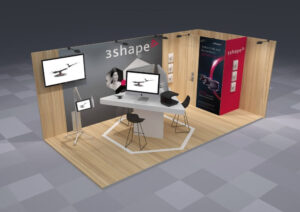
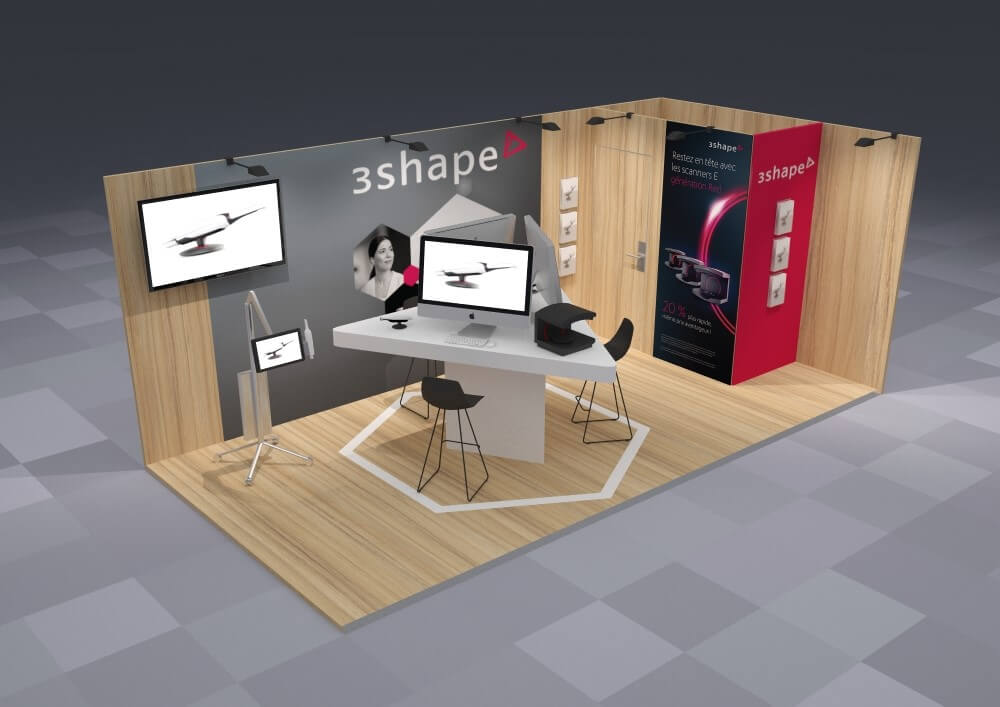
The “customisable” modular stand stands out for its flexibility and its ability to adapt to different events. The modular principle is almost invisible here, a bit like having a Lego set you can assemble differently for each trade show.
In this case, the initial investment is higher, since you purchase (rather than rent) the structures needed to build the stand. However, once you own the components, the assembly and dismantling costs, which still need to be outsourced to professionals, become very affordable. You then benefit from a stand that properly reflects your company’s brand image, with a high level of customisation.
The traditional or “custom built” stand
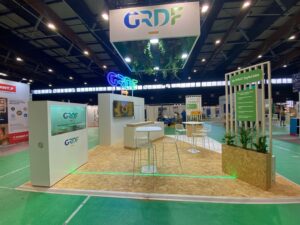
The traditional stand, also known as the custom exhibition stand, is designed specifically to meet the exhibitor’s needs and brief. This type of stand, often created by an exhibition stand builder, is unique and fully tailored to the company’s brand image.
Although these stands are generally more expensive than modular stands, they offer 100% customisation and allow you to create an exhibition space perfectly aligned with your company’s visual identity and objectives. The flexibility is limitless: shapes, sizes, materials, everything is possible to make your stand memorable and exclusive.
These custom stands can be designed for a single event or be rebuildable, which allows the design and production costs to be spread over several events.
Conclusion
Choosing between the different types of exhibition stands depends on many factors: budget, how often you exhibit, the resources available and the image you want to convey. A “basic” modular stand suits companies with limited means, while the “customisable” modular stand or the custom exhibition stand are better suited to those who want to make a lasting impression and strengthen their brand image. By taking these elements into account, you will be able to choose the stand that best matches your objectives and your needs.