

✓ Definition: an eco-friendly exhibition stand is an exhibition space built from durable, recyclable or reusable materials, as part of a drive to reduce environmental impact.
✓ Materials used: certified wood, cardboard, recycled textiles and other responsible raw materials.
✓ Modularity: designed so the stand can be dismantled, transported and reassembled easily.
✓ Reuse: able to be redeployed at several events rather than thrown away after a single use.
✓ Brand image: strengthens the company’s CSR positioning and inspires trust.
✓ Customer appeal: meets the expectations of customers who are increasingly sensitive to environmental issues.
✓ Long-term savings: cuts costs thanks to reuse across several trade shows.
What is an eco-friendly exhibition stand and how does it differ from a traditional stand?
An eco-friendly exhibition stand rests on three core principles: restraint in the choice of materials, reuse across several events and recovery of resources at end of life. Unlike a traditional stand, often built from melamine, PVC or composite materials that are hard to recycle, an eco-friendly exhibition stand favours natural, bio-based or recycled materials.
The difference also lies in the design. A traditional stand is frequently built for a single event, then dismantled and thrown away. An eco-friendly exhibition stand, on the other hand, is designed from the outset to be dismantled, transported easily and reassembled for several trade shows. This approach dramatically limits waste production and the use of new resources at every event.
What are the benefits of an eco-friendly exhibition stand for your company?
Choosing an eco-friendly exhibition stand for your company brings many benefits, both environmental and strategic:
- Enhanced brand image: show a tangible CSR commitment to your visitors and partners
- Long-term savings thanks to reusing the stand at several events
- Visual differentiation from standard stands, which often all look alike
- Compliance with the expectations of trade shows, which impose more and more environmental criteria
Beyond these aspects, an eco-friendly exhibition stand tells a story. It becomes a communication tool in its own right, one that starts conversations with visitors about your values and your approach.
From three trade shows a year, a reusable eco-friendly exhibition stand often works out cheaper than a traditional stand rebuilt for every event. Have both scenarios priced over three years before deciding, the difference is often decisive.
Submit your projectWhich materials should you choose for an eco-friendly exhibition stand?
The choice of materials is the cornerstone of a successful eco-friendly exhibition stand. Several options are available depending on your budget, your visual identity and your specifications.
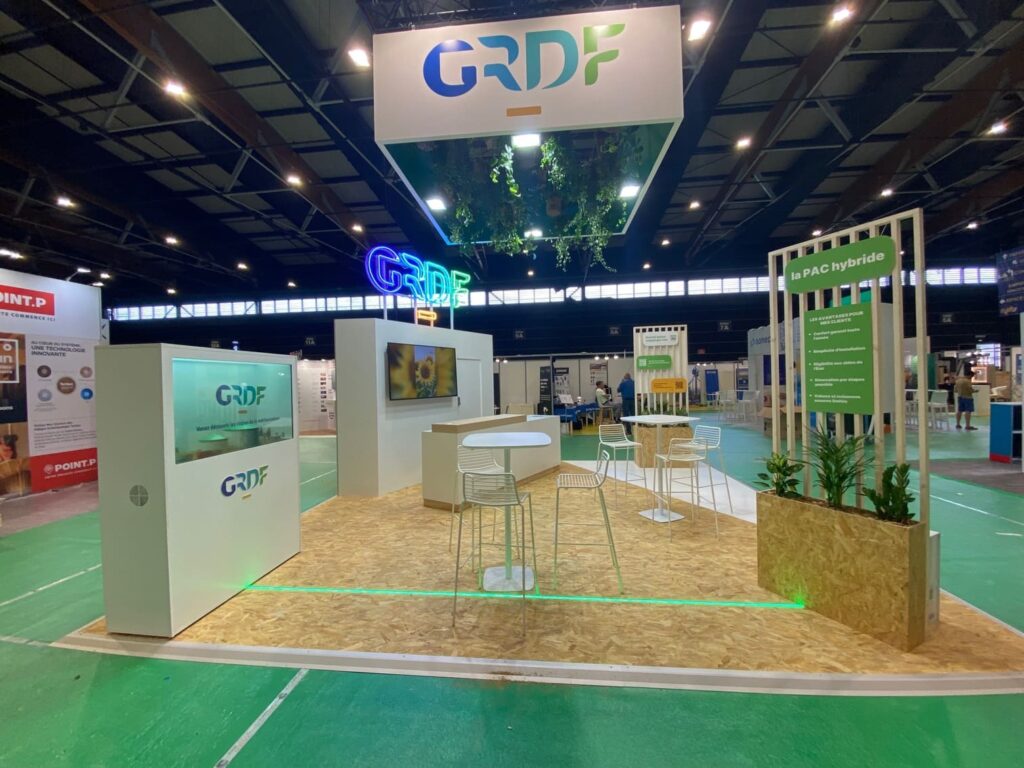
An eco-friendly exhibition stand in wood from sustainably managed forests (FSC or PEFC certification) remains one of the most popular options. Wood brings warmth and authenticity and lends itself perfectly to high-end finishes. It can be dismantled, stored and reused at many events.
The cardboard eco-friendly exhibition stand, built from honeycomb board, wins people over with its light weight, controlled cost and full recyclability. Ideal for one-off events or for companies looking for a resolutely modern, committed image.
Other materials such as recycled textiles (PET from plastic bottles), plant-fibre panels or water-based, VOC-free paints complete the palette available.
How do you create a modular, reusable eco-friendly exhibition stand?
Designing a modular eco-friendly exhibition stand requires thinking ahead. The goal is to treat every element as an independent piece, able to adapt to different surface areas and configurations. A stand initially planned for 12 sqm must be able to grow to 18 or 24 sqm depending on the trade show.
The structural elements must be designed for quick dismantling, without special tools where possible. Visuals printed on recycled textile are preferable to PVC prints, because they fold up, travel in a simple bag and can be washed between two events. Also think about storage between trade shows: a reusable eco-friendly exhibition stand must be easy to store without taking up too much space.
What are some eco-friendly exhibition stand ideas for a trade show?
There is no shortage of inspiration for designing a striking, well-designed eco-friendly exhibition stand. Here are a few creative avenues to explore:
- A preserved green wall to bring a natural touch and visually purify the space
- A welcome counter in sculpted cardboard with personalised finishes
- Signage engraved on wood rather than printed on adhesive
- Low-consumption LED lighting built into the structure
- Eco-designed furniture (cardboard seating, recycled wood tables)
The idea is not to tick every box, but to choose two or three strong elements that will embody your approach while remaining consistent with your brand identity.
How much does an eco-friendly exhibition stand cost in 2026?
How much does an eco-friendly exhibition stand cost?
Answer 8 quick questions to get a personalised estimate
How do you choose a supplier specialising in eco-friendly exhibition stands?
Finding a competent eco-friendly exhibition stand supplier is a decisive step. Several criteria should guide your choice.
First, check transparency about the origin of the materials. A serious supplier must be able to provide the certifications for its wood (FSC, PEFC), justify the origin of its recycled textiles and explain its eco-design approach. Also ask about the end of life of the stands: what happens to them after the event? Are they stored, dismantled, recycled?
Creative support matters just as much. A good supplier does not merely deliver a structure: it helps you design a scenography consistent with your values and your commercial objectives. The ability to offer a professional eco-friendly exhibition stand that is attractive, functional and compliant with trade show rules makes all the difference.
Finally, ask to see past projects. Photos and client testimonials will give you a good idea of the supplier’s level of finish and reliability.
How do you create an eco-friendly exhibition stand without blowing your budget?
Several levers help control the cost of an affordable eco-friendly exhibition stand: choosing cardboard rather than solid wood, opting for a reusable modular format, sharing certain elements across several events, or amortising the same structure over several shows rather than renting again at every edition. Support from a specialist supplier also helps optimise value for money.
FAQ
Is a recyclable eco-friendly exhibition stand really 100% recyclable?
It all depends on the materials used. An eco-friendly exhibition stand in honeycomb cardboard is fully recyclable at end of life. On the other hand, a stand combining wood, textile and metal elements will require selective sorting to recover each component separately. The best approach is to ask your supplier for a complete materials assessment beforehand.
Can you personalise an eco-friendly exhibition stand without compromising its durability?
Yes, a personalised eco-friendly exhibition stand can absolutely keep its environmental qualities. Printing on recycled textile, engraving on wood and water-based paints let you personalise the look of your stand without resorting to polluting materials. The secret lies in the choice of printing and finishing techniques.
What is the difference between renting and building an eco-friendly exhibition stand?
Renting an eco-friendly exhibition stand only makes sense for a single show with nothing planned afterwards: it limits the initial investment but has to be paid again at every edition. As soon as you exhibit more than once, building a custom, reusable eco-friendly exhibition stand becomes more relevant, because the cost is amortised through reuse and the stand better reflects the brand identity.
Is an eco-friendly exhibition stand suitable for every type of trade show?
Absolutely. Whether for a B2B trade show, a consumer event, a commercial fair or a congress, an eco-friendly exhibition stand adapts to every format. More and more organisers even reward exhibitors committed to this approach with extra visibility or specific labels.